|
Education |
|
Despite the fact that education is identified as a
fundamental right in the Indian Constitution, a
large portion of the population remains illiterate.
NBJK strives to avail this basic right to the
children of Jharkhand and Bihar by advocating for
the proper implementation of the education
infrastructure and services, running bridge centers
for children who are working or have dropped out of
school, providing sponsorship for children from
impoverished families and deprived sections of
society, and by strengthening the capacity of
partner NGOs for implementing education projects.
|
|
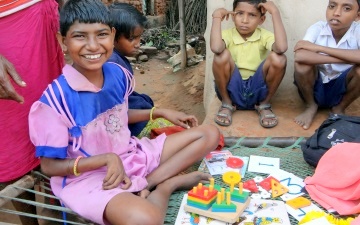
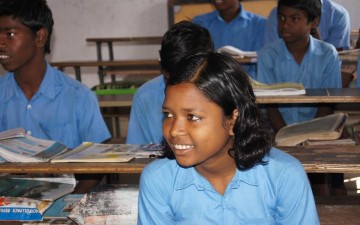
Primary, Middle, and High Schools |
|
 |
NBJK
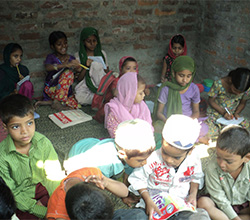
believes that education is a crucial component of
inclusive development and has established a number
of primary, middle, and high schools in urban slums
and in some of the most remote rural villages in
both Jharkhand and Bihar. These schools are supplied
with modern equipment, computers, and laboratories.
There are currently 2700 students enrolled in the
following seven schools: |
-
Amoli
Apurva Primary School, Bahera, Chouparan
-
Amoli
Apurva Primary School, Prajapat Nagar, Mangarh
-
Amoli
Apurva High School, Mangarh
-
Birsa
High School, Deokuli
-
Chandrakala Devi Daga High School, Kewalia
-
Roshani Druv High School, Churchu
-
Surekha Prakash Bhai Public School, Bahera,
Chouparan
The
result of these schools has been very good. The
students are excelling in their studies and passing
at very high rates. Since the onset of this program,
a total of 3000 students have passed through these
schools. |
|
Case Study: |
|
Umesh
Kumar, who belongs to the scheduled caste,
was living with his widowed mother in an interior
village in the Chouparan block of Hazaribag. His
family was dependent on agriculture and labor. With
the assistance of the head master, Umesh was
admitted into the Amoli Apurva High School in class
VI. He was a very intelligent, hardworking student
and was able to pass his Matriculation Board
Examination with impressive results. Interested in
continuing his education, but with no funds to do
so, Umesh began working as a teacher for junior
boys. The money he earned from this allowed him to
pursue his studies. Umesh is currently a history
student working towards a masters degree at the
Vinoba Bhave University in Hazaribag. Umesh
attributes his success to his beginning at Amoli
Apurva High School.
|
|

|
|
Residential
Schools and Hostels |
 |
In order to address the issue of the distance of
schools from villages and to reduce the parents’
financial burden, NBJK is operating three hostels for
young girls in Khunti. These hostels are equipped
with basic amenities and one also provides the girls
with additional coaching classes. There are
currently 150 girls residing in the hostels, 50 in
each. This endeavor has resulted in an increase in
girl students’ school attendance rates. NBJK has also established three residential bridge
camp schools for girls of scheduled castes and
tribes. There are two currently operating in
Chouparan and one in Khunti, housing roughly 115
girls. |
|
These bridge camp schools have been
successful in mainstreaming these girls into the
formal schooling system and reducing the dropout
rate among this population. Assessment tests have
also revealed that many of the girls have been able
to gradually increase their academic level. Since
2005, 695 girls have been provided with education
and housing at the NBJK residential bridge camp
schools. |
|
Case Study: |
|
Anima Nag, a young tribal girl, began her education
in the Oxfam Bridge Camp School in the year 2000.
Her family of seven was very poor and lived in
Angana, a forest village in Chouparan. The family
was supported by what they earned from selling the
forest wood they collected. After Anima completed
her education at the bridge camp school, she was
mainstreamed into the government schooling system
and successfully passed the Matriculation Board
Examination with impressive results. Anima has
continued her education privately and has recently
been appointed by NBJK as a teacher in a bridge camp
school. She is now able to support her family
members on the income she earns.
|
|

|
|
Sponsor a Child’s
Education |
 |
NBJK currently runs Bal Shiksha, a child sponsorship
project designed to provide quality education to
children living in four of the most underprivileged
districts of Jharkhand. There is a particular focus
on adolescent girls who have dropped out of school
or who have never been to school due to a lack of
funds. It is only through education that these
children will have the opportunity to develop the
skills and knowledge to break the cycle of
poverty. With the assistance of donors, this program
has been successful in reaching the most
marginalized and mainstreaming them into the formal
schooling system. To date, 600 young girls have been
sponsored. |
|
Case Study: |
|
Daneshwari Kumari is 16 years old and lives in the
village of Birhu in the Chatra district. She is the
daughter of late Ritu Ganjhu and late Jaswa Devi.
Daneshwari was in class VI when her parents died.
Following their death, she went to reside with her
uncle, Deoki Ganjhu. He was unable to provide for
Daneshwari’s education and she was forced to
discontinue her studies.
NGO staff was made aware of Daneshwari’s situation by the head master of her
former school. The staff met with the uncle but he
refused to allow Daneshwari to return to school
under the program. Other villagers assisted NGO
staff in speaking with and convincing the uncle, who
eventually agreed. Daneshwari returned to her
studies and is now in class VIII.
|
|

|
|
Remedial Coaching Centers |
 |
NBJK, with the support of Axis Bank Foundation, has
implemented 100 Remedial Coaching Centers (RCCs) in
three blocks in the district of Hazaribag in the
state of Jharkhand. There are 33 centers in the
Sadar block, 30 centers in the Churchu block, and 37
centers located in the Chouparan block. The aim of
the RCCs is to improve the performance of
impoverished children in schools and to reduce the
dropout rate among this population. The students are
selected through a process that involves discussions
with the teachers of various schools to determine
which students are struggling and would benefit from
the program. |
|
A
preference is given to girls, children with
disabilities, and those from tribal populations and
scheduled castes. Each center enrolls 40-45 students
for standard VIII, IX, and X. The students are grouped according to
their class, with 10 to 15 students per class. Each
group meets for one hour, Monday through Saturday,
either before or after their formal schooling. There
is one tutor assigned to each center that provides
the students with coaching in Mathematics, Science,
and English. These are the subjects that most
students have difficulties with. In order to instill
a sense of ownership, the students are required to
provide a nominal monthly fee, usually about ten
rupees.
Under this program, there is also one special
educator working in each block that is responsible
for working with children with disabilities in
classes I to X. The special educators make home
visits, providing therapy when necessary. They also
assist families in obtaining disability certificates
and in gaining access to the government benefits
they are entitled to. Aids and appliances are also
distributed to those in need. Since the
implementation of this program, 191 children with
disabilities have been provided with a wide-range of
aids and appliances, including tricycles, crutches,
and hearing aids.
This program was initiated in November 2007 and has
since seen great improvement among the beneficiary
population. Most students are completing the program
and examination scores have increased significantly.
There is also an increased awareness of the
importance of education among the community in the
blocks where the program is operating, resulting in
an increase in enrollment in government schools and
a decrease in dropout rates. Participating girls
have also become increasingly excited about their
studies and are demonstrating an eagerness for
furthering their education, even in the field of
science. The instances of early marriage have
decreased and some girls have even continued their
studies following marriage. |
|
Case Study: |
|
Sintu is a 13 year-old boy in class VIII that
resides in the Selhara village in Chouparan. Sintu
stopped going to school as a result of his neck
being bent towards his right shoulder. Not only did
his classmates tease him, this problem also
interfered with Sintu’s ability to read and write.
NBJK staff successfully persuaded him to join a
Remedial Coaching Center that was running in the off
hours of the government middle school in Selhara.
Discussions were also held with the children in Sintu’s class in order to sensitize them to the
issue. Sintu has also been prescribed a cervical
collar by a doctor and receives physiotherapy from
one of the program’s special educators. He has shown
great improvement and is now a regular student.
|
|

|
|
Lord Buddha Home for Children |
 |
The Lord Buddha Home for Children (LBHC) was
established in 2004 as a result of an initiative of
the Dutch foundation, Stichting Kinderhulp Bodghaya.
The LBHC is an orphanage in the village of Silounja,
near Bodghaya. The goal of this home is to create an
equal standard of living for poor and orphaned
children by providing them with proper care in a
loving environment and by providing them with a
quality education in an English medium, CBSE
recognized school. In addition to shelter and
education, the children are also provided with all
of their food and clothing requirements. |
|
There are
currently 47 children at the LBHC and there is one
housemother to serve as the primary caregiver for
every ten children. The daily routine is well
organized and consists of education, health, sports,
and entertainment. The LBHC also provides the
children with daily sessions with a home tutor and
weekly visits from a doctor. |
|
Case Study: |
|
Sumant Kumar, 10 years old, came to the Lord Buddha
Home for Children (LBHC) as a young child, following
the early death of his parents. Sumant’s mother
passed away due to a chronic illness and his father
was killed by a bite from a snake. Sumant’s uncle
became the immediate guardian of him and his
adolescent sister, treating them as domestic
servants.
When he came to LBHC, Sumant found a very
different life, one with love and inspiration.
Sumant excels at school, achieving a 96% on the
annual school examinations and ranking 3rd in his
class. He is also very athletic, enjoying sports and
dancing. Sumant is also developed into a very kind
and helpful young man. He offers assistance to the
housemothers and looks out for his juniors. Sumant
acknowledges the differences and claims that LBHC
has transformed his life.
|
|

|
|
Gopal Bal Vidyalaya
|
|
The Gopal Bal Vidyalaya educational institution was
created in 2006, with the financial support of Mr.
Sunil Walia. It is located in the very poor and
uneducated Velwatand hamlet in the village of
Silounja (Gaya). This school provides the children of
this deprived community with a quality education up
to Standard II and prepares them to be mainstreamed
into the government schooling system. Since the
establishment of this center, many students have
been successfully mainstreamed into the government
middle school in Bodhgaya. There has also been a
significant shift in the attitudes of the villagers
concerning education. |
|

|
|
JP
Academy for Slum Children |
|
NBJK, with the assistance of The Association for
India Development, has implemented a program to
provide education to the children in the slum areas
of Patna, the capital city of Bihar. Many of the
children in living in these areas have dropped out
of the formal education system to earn additional
income for their families. With the aim of providing
an education for these children and sensitizing
impoverished communities to the importance of
education, nine primary education centers have been
developed in the Patna slum areas. Since the
program’s initiation, parents have begun to
prioritize education for their children and many
have been mainstreamed into nearby government or
private schools to further their studies. |
|

|
|
Spandan |
 |
With the support of the Hans Foundation, Spandan was
implemented by NBJK in 2005. This program provides
education to children with Cerebral Palsy and Mental
Retardation in 46 villages in the Sadar block of
Hazaribag. Spandan also provides aids and
appliances, family counseling, physiotherapy
sessions, and training on activities of daily living
and functional reading/writing. The ultimate goal of
this program is to assist these children in becoming
more independent in their daily lives and
mainstreaming them into society. Many of the
children have made great improvements in their
capabilities as a direct result of this program. |
|
Case Study: |
 |
Saniya Praween II is 5 years old and suffers from
comorbid delayed development and a moderate level of
mental retardation. Her family resides in Pelawal
village in the district of Hazaribag and is
supported by her father’s work as a tailor. Prior to
the intervention of the Spandan program, Shaniya’s
condition was very poor. She was unable to stand on
her own and did not have a disability certificate.
Thus, she was not receiving any government
benefits. Once enrolled in the program, a special
educator from NBJK assisted Shaniya in getting
certified. |
|
She
is also receiving physiotherapy and is working on
her activities of daily living twice a week with
this special educator. Her mother has been
provided with training in physiotherapy, ADL, and
social interaction so that she is also able to work
with Shaniya. These efforts have resulted in great
improvements. Shaniya is now able to stand on her
own and is even able to take a few steps without
support. Her family is very pleased with and
grateful for this progress. |