| |
 |
|
 |
|
|
|
|
|
Solid Waste
Management and Sanitation |
|
Urban
sanitation is a huge problem in Jharkhand and
Bihar. The municipalities have not been very
effective in managing this problem and cleanliness
and waste disposal issues persist. NBJK first
intervened in Ranchi in an attempt to use it as a
model for how, with the support of the people,
NGOs, and the government, a city is able to
achieve a high level of cleanliness and
sanitation. NBJK has since increased its scope to
include other areas in Jharkhand and Bihar.
|
|
Clean
Jharkhand Program |
 |
In
response to the need for a simple and participatory
system to manage solid waste on a large scale, the
Clean Jharkhand Program was established by NBJK. The
Clean Jharkhand Program is one of the most
innovative solid waste management programs
implemented in the country. A door-to-door waste
collection service is offered in the urban areas of Ranchi, Hazaribag, Dhanbad, Ramgarh, and Patna. This
program has served a total of approximately 51,000
households. This service is also extended to
hospitals, office buildings, government quarters,
and commercial complexes. |
|
In
Hazaribag, this program is providing quality
services to the government hospital, as well as the
offices and residential complexes of Damodar Valley
Corporation. The user fees that are collected allow
this program to be operationally sustainable. The
revenue for this past year was Rs.8,224,800.
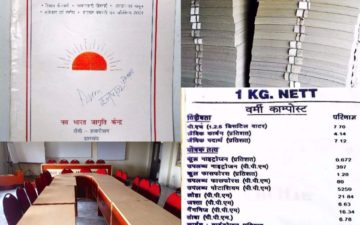
The Resource Recovery Division of the project takes
the collected waste and recycles it into millboard
and compost, which is then sold at a profit. The
Vermin Compost Plant in the Chuttu village in the
Ormanjhi block of Ranchi uses the non-paper waste
that is collected as compost, producing more than 250
MT of fertilizer each year. This fertilizer is
branded as “Lok Vermi Compost” and is sold to
farmers through retail agents and shops in Ranchi
and other surrounding areas. The Millboard
Production Unit in the village of Chakla near Ranchi
utilizes a cost-effective, modern technique to make
530 MT of millboard from paper waste each year.
Millboard is a multipurpose product sold in the
local market and is branded as green.
In addition to improved sanitation in urban areas,
the Clean Jharkhand Program is providing wage
employment for those responsible for collecting the
waste. Roughly 500 people are currently employed
under this program. Due to the success of the
project, other municipalities have implemented
similar garbage collecting programs. |
|
Case
Study: |
|
Ashok
Nagar is a posh neighborhood in Ranchi that
comprises of 500 residential units. The Ashok Nagar
Housing Cooperative Society, which manages the
units, approached NBJK in 2006 and arranged for the
Clean Jharkhand Program (CJP) to take care of the
overall cleanliness of the area. CJP implemented
doorstep waste collection, in addition to street
sweeping and drain cleaning. The waste collected is
brought to a transit point and sent to a disposal
site in Jhiri. This waste management work has
generated a livelihood for eight people. Satisfied
with the professionalism and quality of the work,
the Ashok Nagar Housing Cooperative Society has also
asked the CJP to take over the task of fogging to
control the mosquito and fly populations in the
area. Ashok Nagar is now regarded as the cleanest
area in Ranchi and the awareness of the residents
has been significantly increased. |
|

|
|
Water, Sanitation and Hygiene |
 |
Those
living in urban slum areas have less access to
water, sanitation, and hygienic conditions. In an
effort too address this issue, Water Aid India has
been sponsoring NBJK’s integrated water, sanitation,
and hygiene program in 20 urban slum areas in the
Ranchi municipal area since 2005. The project aims
to improve the overall sanitary conditions and civic
amenities in these areas by providing safe drinking
water, individual toilets, and by renovating
community sanitary complexes. Awareness raising and
advocacy are also vital components of the program.
Since the implementation of this program, |
|
568
household toilets, 14 waste compost pits, and 452
soak pits have been constructed.1400 feet of drain
has also been constructed and repaired and 5
community toilets have been renovated. |
|
Case
Study: |
|
Nirmala Devi is a 53 year-old woman living in
Rugrigara, an urban slum area of Ranchi. She is
physically challenged and resides with her daughter
and son-in-law. Nirmala struggles to walk and is
unable to sit properly. Thus, using the toilet and
bathing were very difficult tasks. Nirmala was
eventually forced to resort to the use of plastic
bags for defecation purposes. Some of the neighbors
objected to this and would insult her. When the
issue was raised at a meeting of a local slum
development committee, sensitive members proposed a
permanent solution. NBJK has provided Nirmala with a
specially designed toilet, allowing her to restore
and maintain her dignity. |

|
|
|
|