| |
 |
|
 |
|
|
|
|
|
Small Group
Support, Advocacy and Governance |
|
Achieving the goal of a just and developing society
in Jharkhand and Bihar will remain elusive without
good governance. To fill the gap created by weak
governmental support, NBJK has been advocating for
the people’s rights through various platforms and
emphasizing good governance, with a focus on the
grassroots level. Accountability within the delivery
system, transparency, and rationalization of
government schemes are priorities under this
program. It is crucial that the real stakeholders,
the people, are aware of their rights and are
empowered to advocate for these rights. Thus, NBJK
strives to support existing grassroots level
voluntary organizations.
|
|
Small
Group Support |
 |
From
its inception, NBJK has held the belief that there
is a great need for strong voluntary movements in
society. A number of social workers, activists,
change seekers, and socially committed people would
be able to accomplish great things if provided with
the proper guidance and support. Under this program,
NBJK identifies grassroots level voluntary
organizations (VOs) in the state of Bihar and
Jharkhand and strives to develop their capacity and
scope.
NBJK has provided 350 small NGOs technical support
and more than 500 with financial support to
implement various socio-economic development
programs. |
|
In
order to improve communication and increase
capacity, these scattered VOs of Bihar and Jharkhand
have been organized under the banner of Jharkhand/Bihar
Swaichhik Manch. These small groups
implement developmental projects, as well as promote
the Lok Samitis (People's Institutions) in their
respective working areas in order to empower people
as custodians of democratic processes and
entitlements. |
|
Case
Study: |
|
Veer
Jharkhand Vikas Sewa Manch of the Lochanpur village
in the district of Koderma is a local voluntary
group registered in 2002. It is a partner
organization of NBJK and receives a fellowship under
the Bread for the World (BFW, Germany) supported LAI
project. NBJK identified this small but active NGO
during Lok Samiti and Swaichhik Munch meetings. It
was discovered that neglected documentation, due to
a lack of awareness, was the main barrier to the
organization’s growth and success. After joining our
Local Initiatives project, it secured the requisite
legalities and has mobilized women in base contact
areas. Veer Jharkhand has promoted more than 200
Self Help Groups and has provided them with training
in the making of incense sticks, candles, washing
soap/powder, and vermin compost. 20 groups were also
linked with the dairy industry under the SGSY
scheme. More than 900 women are direct beneficiaries
of such initiatives. Veer Jharkhand has also been
nominated for a Nirmal Gram Award for its sanitation
work in the Bekowar and Dumardiha panchayats. |
|

|
|
Lok
Samiti |
|
Lok
Nayak Jai Prakash Narayan founded the non-political,
democratic organization Lok Samiti, people’s
committee. NBJK nurtured and expanded Lok Samiti to
700 panchayats of Jharkhand and Bihar. Lok Samiti is
a strong grassroots organization that supports human
rights, democratic values, and advocating for those
most marginalized in society. Through Lok Samiti,
NBJK is propagating a continuous campaign in favor
of 50% reservation for women in all sectors and in
panchayat elections in Jharkhand. Parliament and the
Supreme Court have recognized both of these issues.
Advocacy programs have also been organized to
address proper health facilities in rural areas, the
certification and rehabilitation of people with
disabilities, proper implementation of MANREGA,
farmer’s issues, female feticide, etc. |
|

|
|
Family Counseling Center |
|
 |
Due
to the time and expense involved in the judicial
process, NBJK, under the guidance of the central and
state Social Welfare Board, has been running a
Family Counseling Centre (FCC) in the district of
Hazaribag since 1993. The centre provides family
counseling and legal aids to socially exploited men
and women.
The
FCC attempts to resolve a variety of familial
issues, including marital dispute, separation or
divorce, dowry atrocity, and property encroachment.
The centre is known for its prompt response and
continuous follow-up of the cases. 130 cases have
been solved this year, making a total of 1249 cases
solved since the onset of this program. |
|
Case
Study: |
|
Gangia Devi and her husband Bhuneswar Sahu reside in
Oria village in the district of Hazaribag. They were
compelled to leave their dilapidated house during
the rainy season due to a lack of funds available
for necessary repairs. Deva Sahu, the only son of
the elderly couple, was residing with his wife and
children in the pucca part of the old structure. He
did not provide any assistance to the couple. One of
the neighbors suggested that Gangia contact the
Family Counseling Center. Gangia took the advice and
came to the center in July 2009. NBJK counselors met
with family members, neighbors, and prominent
members of the village. A meeting was called in
August and it was decided, unanimously, that Deva
would construct a pucca house for his parents.
Initially, Deva’s wife, Bindeshwari, interfered with
the process. But, social mobilization and a warning
of legal action solved this problem and Deva soon
completed a pucca house for his mother and father. |
|

|
|
Swaichhik Munch |
 |
In
Jharkhand, 375 non-governmental and voluntary
organizations from 23 districts in Jharkhand have
come together to form Swaichhik Munch, a platform
for member organizations to share their experiences
and discuss issues plaguing their communities. NBJK
also coordinates capacity building trainings for
participating organizations.
Swaichhik Munch has also
been expanded to 33 districts in Bihar, with a total
of 300 member organizations. Regular meetings are
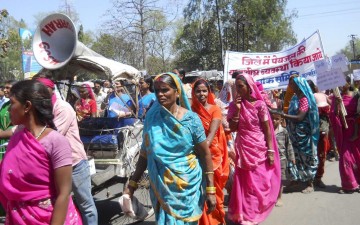
held and demonstrations are organized in response to
current issues in the state. |
|

|
|
Kopal |
 |
Due
to the gradual deterioration of the female to male
sex ratio in Jharkhand, Kopal has been implemented
to reduce female feticide practices and to promote
birth registration, per the PCPNDT Act 1994 and RBD
Act 1969. Since January 2010, Plan International has
provided support for this initiative. The program is
operating in the Sadar blocks in the districts of
Ranchi, Hazaribag, Palamu, Koderma, and Deoghar,
where the there are only an estimated 875-900 female
children, aged 0-6, for every 1000 male children,
aged 0-6, in urban areas.
|
 |
|
|
|